If you want the short answer: C-Label checks the meat, while B Corp checks the business.
If I’m looking at Cultivated Meat, I’d read these labels in two different ways:
- C-Label tells me about the product
- B Corp tells me about the company
- C-Label looks at animal welfare, growth media, and safety
- B Corp looks at governance, workers, community, customers, and company impact
- One label does not replace the other
That split matters because 100% of the difference comes down to scope: one is product-level, the other is company-level. So if you want to know whether a specific item is slaughter-free, animal-free in its growth media, and checked for safety limits, C-Label is the label to read. If you want to know how a firm treats people, runs the business, and manages its overall impact, B Corp is the one to watch.
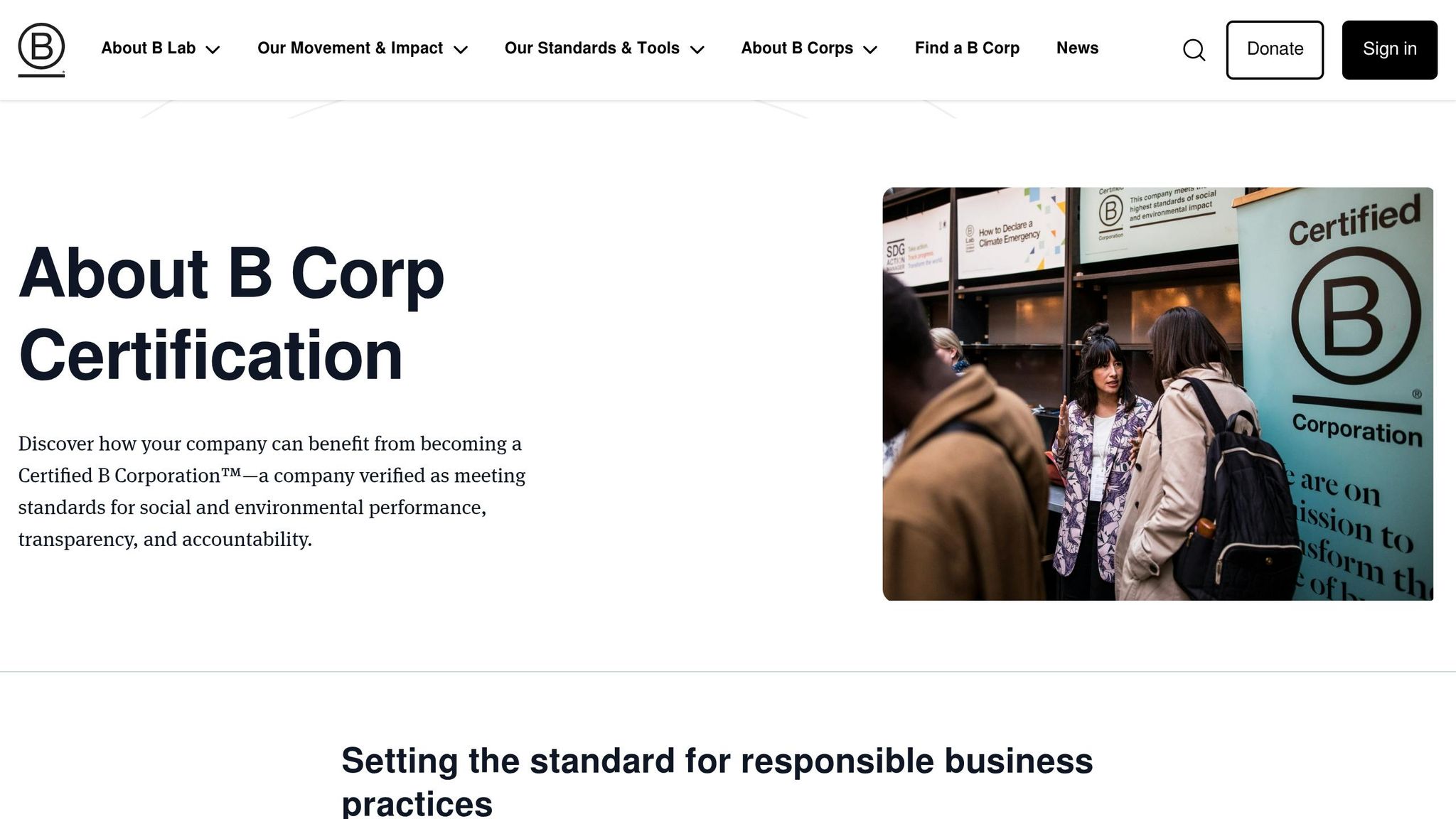
An introduction to B Corp Certification
sbb-itb-c323ed3
Quick Comparison
| What you want to know | C-Label | B Corp |
|---|---|---|
| Checks a specific Cultivated Meat product | Yes | No |
| Checks the whole company | No | Yes |
| Covers animal welfare in production | Yes | No |
| Covers growth media rules | Yes | No |
| Covers product safety checks | Yes | No |
| Covers workers and governance | No | Yes |
| Covers community and customers | No | Yes |
| Tells me how the meat was made using specific production methods | Yes | No |
| Tells me how the business is run | No | Yes |
Put simply: C-Label answers “What is this product?” and B Corp answers “What sort of company made it?” I’d use both together if I wanted the clearest view before buying.
C-Label: what it checks on a Cultivated Meat product
C-Label is a product-level certification for Cultivated Meat. It looks at how one product is made, not the company behind it.
Core C-Label criteria: animal welfare, media and safety
C-Label covers three areas. Each one speaks to a different concern a shopper may have.
On animal welfare, it checks that no animals were killed during cell sourcing or production. It also requires the origin of the cell line to be disclosed.
On production inputs, it requires animal-free growth media. That means no fetal bovine serum and no other animal-derived ingredients. It also does not allow antibiotics in production.
On food safety, C-Label checks that the final product is non-GM. It also looks at pathogen control during production and checks that contaminant levels stay within safety limits.
What C-Label does and does not tell consumers
C-Label tells you what went into the product and how it was made. That’s useful if you want a clear view of the product itself.
But it doesn’t cover everything. It does not deal with carbon footprint, corporate governance, or worker welfare. So its product-level focus answers one set of questions, while B Corp answers another.
B Corp: what it checks across the whole company
B Corp looks at the company behind the product, not the product itself. It reviews the whole business across governance, workers, community, environment, and customers. For Cultivated Meat buyers, that means looking at the business behind the product, not just what ends up on the shelf.
The main B Corp impact areas
B Corp assesses companies across five core areas: governance, workers, community, environment, and customers.
Companies can also earn Impact Business Models (IBMs) for stand-out strengths. One example is 'Mission Locked', which protects a company's mission through its governing documents so stakeholders are considered in decision-making. Another is 'Resource Conservation', which recognises lower energy and water use.
Why B Corp matters, and its limits for Cultivated Meat shoppers
For shoppers, B Corp signals company-wide accountability for social and environmental performance.
But there’s a clear limit. It does not certify product-level production, safety, or technical standards. That’s where C-Label steps in. This company-level focus sets up the C-Label vs B Corp comparison in the next section.
C-Label vs B Corp: the key differences
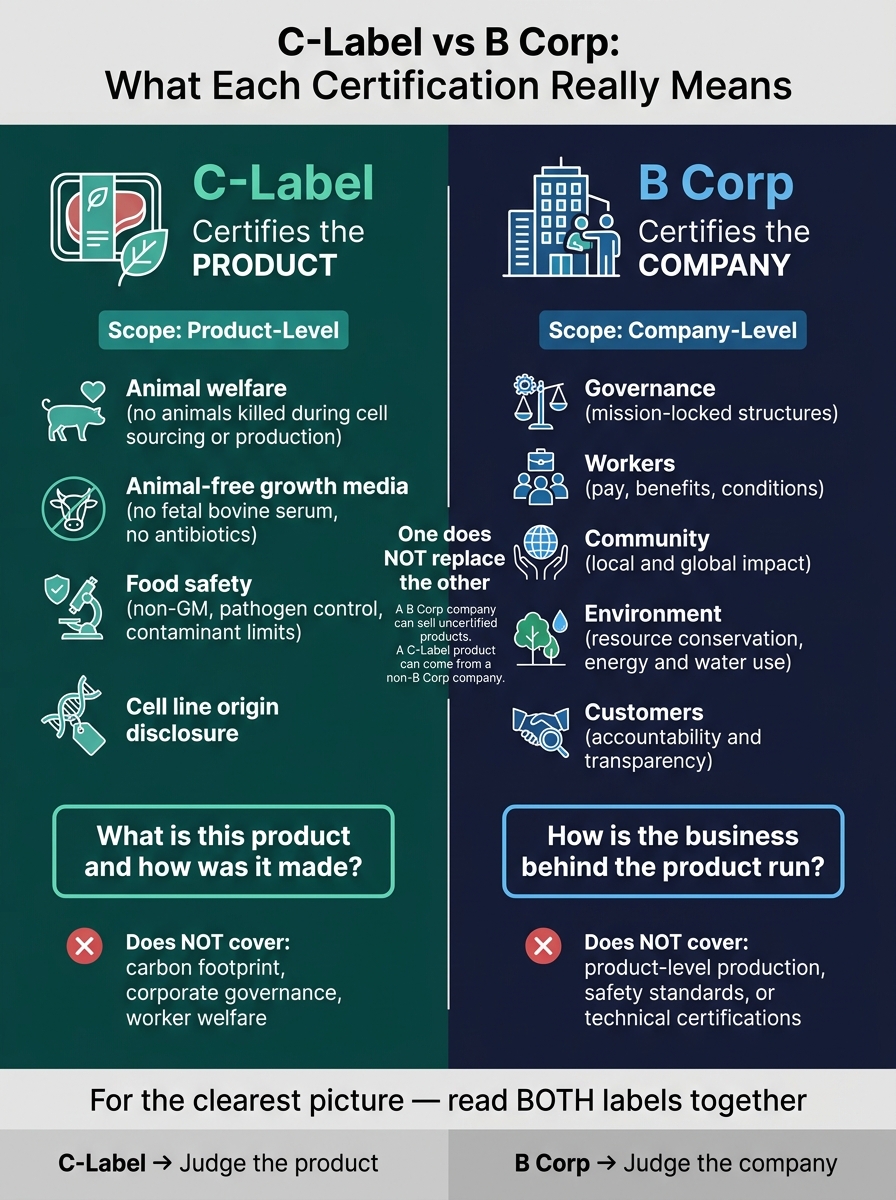
C-Label vs B Corp: Product vs Company Certification Explained
The main difference is straightforward: C-Label certifies a specific Cultivated Meat product. B Corp certifies the company behind it. They answer two different questions. Look to C-Label for product claims, and B Corp for company claims.
Product-level certification vs company-level certification
C-Label checks a specific Cultivated Meat product and the way it was made - including animal welfare standards, growth media inputs, and the safety of the final product on the shelf. B Corp looks at the business as a whole: workers, governance, communities, and the environment.
That means a B Corp-certified company can still sell a product without product-level certification. And a C-Label product can come from a company that does not have B Corp status.
The contrast becomes clearest when you compare scope, criteria, and what each label tells a shopper.
| Feature | C-Label | B Corp |
|---|---|---|
| Scope | Product-level | Company-level |
| Certified scope | Specific Cultivated Meat product and its production process | The entire business and its operations |
| Key criteria | Animal welfare, growth media inputs, and food safety | Governance, workers, community, environment, and customers |
| Environmental coverage | Product-specific inputs and process transparency | Resource use across the business |
| Tells you | How the meat was made | How the business is run |
| What it tells you | Verifies the what and how of the food | Verifies the who behind the food |
Which label answers which consumer question
C-Label tells shoppers whether a single product meets set production and safety rules. B Corp tells shoppers whether the company is answerable for its broader impact. B Corp shows company-level accountability, not product-level certification.
Conclusion: how to read both labels together
C-Label and B Corp speak to two different things. C-Label is about the product. B Corp is about the company. That gap matters most when a brand has one label but not the other.
Take Mosa Meat. It has B Corp status, but that does not certify any specific product. Instead, it points to the company’s broader mission and how it uses its resources. What it does not tell you is whether a given product has been certified.
Key takeaways for consumers
Read C-Label for the product. Read B Corp for the company, or use a checklist for understanding cultivated meat labels. When you look at both together, you get a clearer picture: one label helps you judge the product, and the other helps you judge the company.
FAQs
Can a product have C-Label without the company being B Corp?
Yes. A product can have C-Label certification even if the company behind it is not B Corp certified.
Here’s the simple difference:
- C-Label applies to a specific product
- B Corp looks at the company as a whole
So while C-Label focuses on standards for Cultivated Meat production, B Corp assesses a business’s social and environmental performance, along with accountability and transparency.
They’re separate, independent certifications.
Does B Corp say how the meat was made?
Yes. B Corp certification looks at a company’s overall social and environmental performance, along with its accountability and transparency.
That means it reviews areas like governance, mission, environmental practices, workers’ welfare, and supply-chain practices.
But there’s an important catch: the results mentioned here don’t spell out how the meat itself was made. So while the certification says something about the company as a whole, it doesn’t give product-level detail on the meat production process.
Which label matters most when buying Cultivated Meat?
When buying Cultivated Meat, the label that matters most is the one that tells you who checked it, what they checked, and which standards the product met.
With C-Label and B Corp, both point to verified responsibility. But if you're weighing them up, put more weight on the certification with the most specific requirements and the strongest independent checks for the claims you care about most.