Most food labels do not tell me enough on their own. If I want to make better food choices, I need to know what the claim means, who checked it, and whether it applies to the product or just the company.
Here’s the short version:
- Certification is an independent check against set rules.
- It helps turn pack claims into something I can compare.
- Product labels like Organic, Fairtrade, and carbon footprint marks each check different things.
- Company labels like B Corp look at the business as a whole, not every item it sells.
- For Cultivated Meat, this matters even more because impact can change a lot based on energy use, water use, waste, land use, and antibiotic claims.
- Clear wording matters too. Research found 80% of people could tell Cultivated Meat from conventional meat, but only 67% could tell it from plant-based meat.
If I’m standing in a shop and trying to make sense of a label, the rule is simple: match the label to the claim. A carbon label is not the same as Organic. A company badge is not the same as a product check. And for Cultivated Meat, independent checks will matter if brands want people to trust claims on climate, water, land, or ingredients.
| Label or Standard | What it applies to | What it tells me |
|---|---|---|
| Organic | A specific product | How it was farmed |
| Fairtrade | A specific product | How sourcing rules were met |
| Carbon footprint label | A product or range | Its emissions, often in kg CO₂e |
| B Corp | The whole company | How the business performs across social and governance areas |
So my takeaway is simple: certification does not answer every question, but it does make food claims easier to check. That is a big help when newer products, like Cultivated Meat, start appearing on UK shelves.
What food sustainability certification actually means
Certification is an independent check against published standards. In plain terms, a third party - not the brand selling the product - reviews a product or company and decides whether it can use the label.
That changes a claim from something a brand simply says into something that can be tested. And that matters most when a label needs to show exactly what has been checked.
How third-party verification builds trust
Third-party verification applies the same standard each time. So shoppers aren't left to rely on a brand's wording alone.
That point matters even more when language gets murky. Research from GFI Europe and Opinium found that technical or loaded wording - words like "artificial" or "synthetic" - is often seen as misleading, while clearer qualifiers such as "cultivated" help people understand what they are buying [1]. For Cultivated Meat, that clarity matters because shoppers need to separate verified claims from marketing language.
What certification can measure
Certification doesn't just help with trust. It also sets out what can be measured.
Depending on the scheme, that can include production methods, environmental impacts, labelling and safety-related claims. In Cultivated Meat, certification can also check composition, labelling and safety compared to traditional meat. That's especially important when allergen information or ingredient claims need clear verification.
sbb-itb-c323ed3
Which certification labels are most useful for UK shoppers
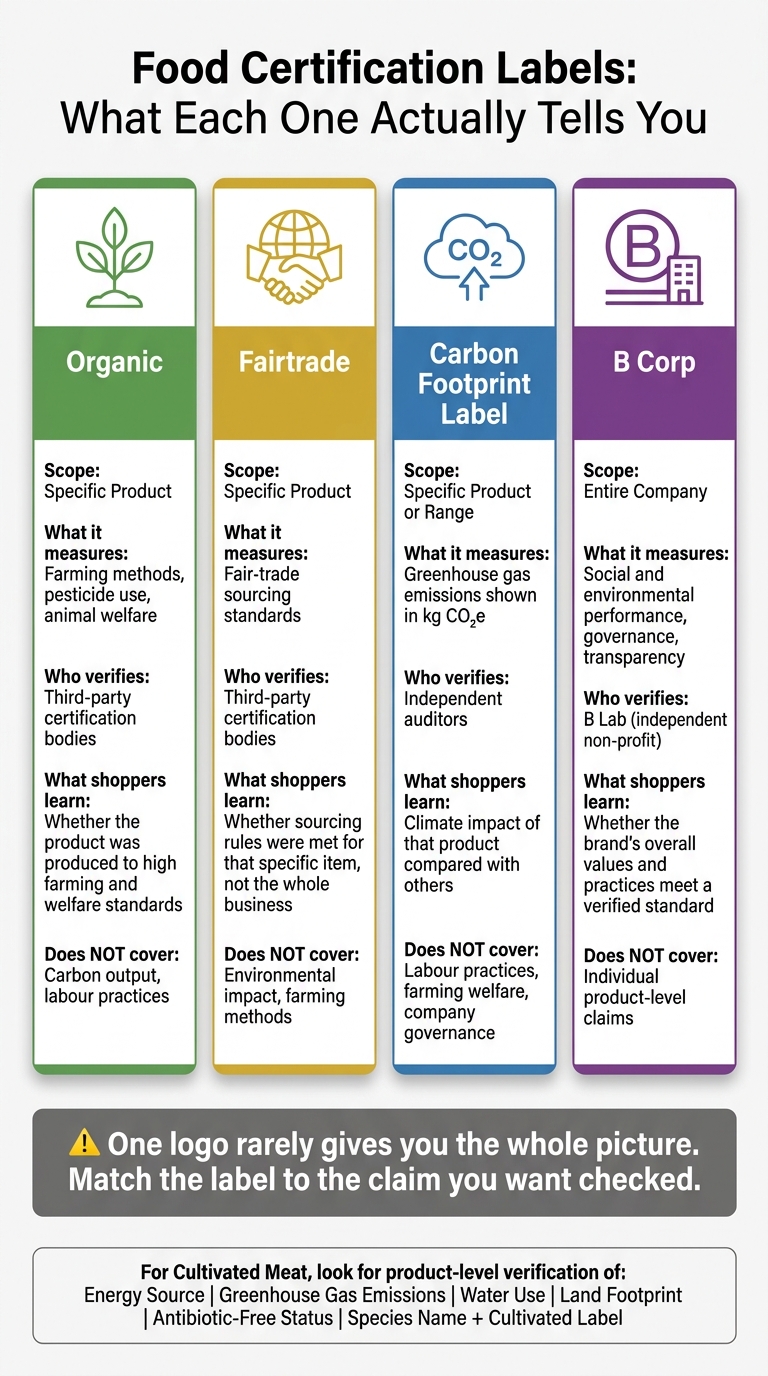
Food Certification Labels Compared: Organic, Fairtrade, Carbon, B Corp & Cultivated Meat
Once you've checked that a certification is legitimate, the next step is simpler: work out what the label is actually telling you.
Not all labels do the same job. Some are about the product itself. Others are about the company behind it. If you mix those up, it's easy to assume a label says more than it does.
Organic, Fairtrade and carbon footprint labels
Organic certification is about farming methods. It tells you a product was grown or raised under rules covering pesticide use and animal welfare. What it doesn't tell you much about is a company's carbon output or labour practices.
Fairtrade is also a product-level label. In plain English, it applies to a specific product, not the whole business.
Carbon footprint labels, including those checked by independent auditors, focus on a product's greenhouse gas emissions, usually shown in kg CO₂e. That's helpful if you're trying to compare products on climate impact. But there's a catch: the label only reflects what has been measured and audited. A product might have a carbon label and still come with other sustainability issues that aren't covered.
One logo rarely gives you the whole picture. Each label answers one question, not every question.
Company-level standards versus product-level labels
A product-level label - such as Organic, Fairtrade or a carbon mark - applies to a specific product. It tells you something that can be checked about that product's production, ingredients or environmental impact.
A company-level standard, such as B Corp certification, works at business level. B Corp is awarded by the independent non-profit B Lab and looks at a company's overall social and environmental performance, governance and transparency. That means the business, taken as a whole, clears a high bar. But it does not mean every single product it sells clears that same bar.
Here's the difference at a glance:
| Label Type | Scope | What Is Measured | Who Verifies | What the shopper learns |
|---|---|---|---|---|
| Organic | Specific product | Farming methods, pesticide use, animal welfare | Third-party certification bodies | Whether the product was produced to high farming and welfare standards |
| Fairtrade | Specific product | Fair-trade sourcing standards | Third-party certification bodies | Whether the label applies to a particular item rather than the whole business |
| Carbon Footprint | Specific product or range | Greenhouse gas emissions (kg CO₂e) | Independent auditors | The climate impact of that product compared with others |
| B Corp | Entire business | Social and environmental performance, governance | B Lab (independent non-profit) | Whether the brand's overall values and practices meet a verified standard |
For shoppers, the rule is simple: match the label to the claim you want checked.
For Cultivated Meat, the main point is whether the label verifies the product itself or the business behind it. Understanding what cultivated meat is helps shoppers identify which production claims require the most scrutiny.
How certification supports informed choices on Cultivated Meat
Cultivated Meat can make strong sustainability claims, but shoppers need proof from an independent source. Certification turns those claims into evidence people can check and compare.
For Cultivated Meat, that matters a lot because the biggest claims about sustainability depend on how each product is made. Two products may sit in the same category, yet their impact can look quite different once you look at energy, water, and waste.
What certification could verify for Cultivated Meat
Verification could cover energy source, greenhouse gas emissions, water use and recycling efficiency, land footprint, and waste handling. Because results vary between producers and production methods, third-party verification is the only dependable way to confirm what a specific product actually delivers.
Because Cultivated Meat is still meat, verified labels should also make the species clear, so shoppers can recognise both the product and its allergen profile. Clear labels using the species name plus "cultivated" make that much easier at a glance.
Comparing verified impacts with conventional meat
A comparison of sustainability factors shows why certification matters.
| Sustainability Factor | Conventional Meat | Cultivated Meat Potential | Role of Certification |
|---|---|---|---|
| Land Use | High - grazing land and feed crops | Significantly lower - vertical production | Verifies actual land footprint reduction |
| Climate Impact | High - methane from livestock, feed production and transport; moderate energy demand | Lower emissions potential, but dependent on energy source and bioreactor energy intensity | Confirms renewable energy use and validates emissions claims against stated figures |
| Water Use | High - livestock hydration and crop irrigation | Potentially lower | Measures water recycling rates and efficiency |
| Antibiotic Use | Routine in many conventional systems | Reduced or absent | Verifies "antibiotic-free" status independently |
The table shows the core point: Cultivated Meat may have an edge in several areas, but that edge is not automatic. A product made with high-energy inputs tells a different story from one made with cleaner power and tighter resource use. Certification helps turn those differences into something a shopper can read, trust, and compare without guessing.
How Cultivated Meat Shop helps consumers stay informed
For UK shoppers, the practical step now is to learn which certification signals to look for when products arrive. Cultivated Meat Shop helps UK shoppers track Cultivated Meat updates and the certification signals to watch for.
Conclusion: How certification makes sustainable food choices clearer
Certification turns sustainability claims into independently checked evidence. It moves a label beyond marketing language and into something a third party has verified.
The next step is simpler, but just as important: knowing what each label actually proves.
Organic, Fairtrade, and carbon labels do different jobs. Each one answers a different question, so shoppers need to match the label to the claim. That matters even more for Cultivated Meat, where the claim depends on how the product is made.
As Cultivated Meat reaches UK shoppers, clear, verified labels will make sustainable choices easier to compare. This transparency is vital for understanding the environmental benefits of cultivated meat compared to traditional farming.
FAQs
Which labels can I trust most?
Look for official approval from the Food Standards Agency (FSA) and Food Standards Scotland (FSS). That tells you the product has been checked for safety and quality under UK rules.
Then read the label closely. It should clearly show the ingredients, allergen warnings, production source, cell origin, and batch traceability.
Does B Corp mean a product is sustainable?
No. B Corp certification does not automatically mean a specific product is sustainable.
What it can show is a company’s broader ethical and environmental commitments. But that’s not the same thing as product-level safety and quality approval.
If you’re in the UK, check for official regulatory endorsements, such as those from the FSA or FSS.
How will Cultivated Meat be certified?
In the UK, Cultivated Meat has to go through a strict safety and quality approval process run by the Food Standards Agency (FSA) and Food Standards Scotland (FSS).
Before any product can be sold, regulators check key areas such as safety, hygiene, traceability and labelling. Producers also need to meet rules around HACCP, allergy checks and nutrition checks.
This means Cultivated Meat can’t just appear on shelves. It has to pass a detailed review process first, with clear standards on how it’s made, tracked and labelled.