Cultivated fat is transforming how meat tastes by offering precise control over flavour, texture, and aroma. Unlike conventional fat, it’s grown in controlled conditions, allowing for customisation of fatty acid profiles and aroma compounds. Here's how it enhances meat:
- Boosts Juiciness and Texture: Adds moisture and improves mouthfeel, mimicking the fatty acids found in pork and other meats.
- Deepens Flavour: Releases volatile compounds during cooking, creating rich, savoury notes similar to conventional fat.
- Promotes Browning and Aroma: Helps achieve a golden crust and releases meaty, roasted aromas when heated.
- Improves Tenderness: Recreates marbling patterns, enhancing meat's softness.
- Customises Aroma Profiles: Fine-tunes scents for specific meats like beef or chicken while reducing off-notes.
Cultivated fat not only replicates the sensory qualities of conventional fat but also allows for reduced saturated fat and consistent flavour. It’s a step forward in creating meat alternatives that satisfy taste and cooking expectations.
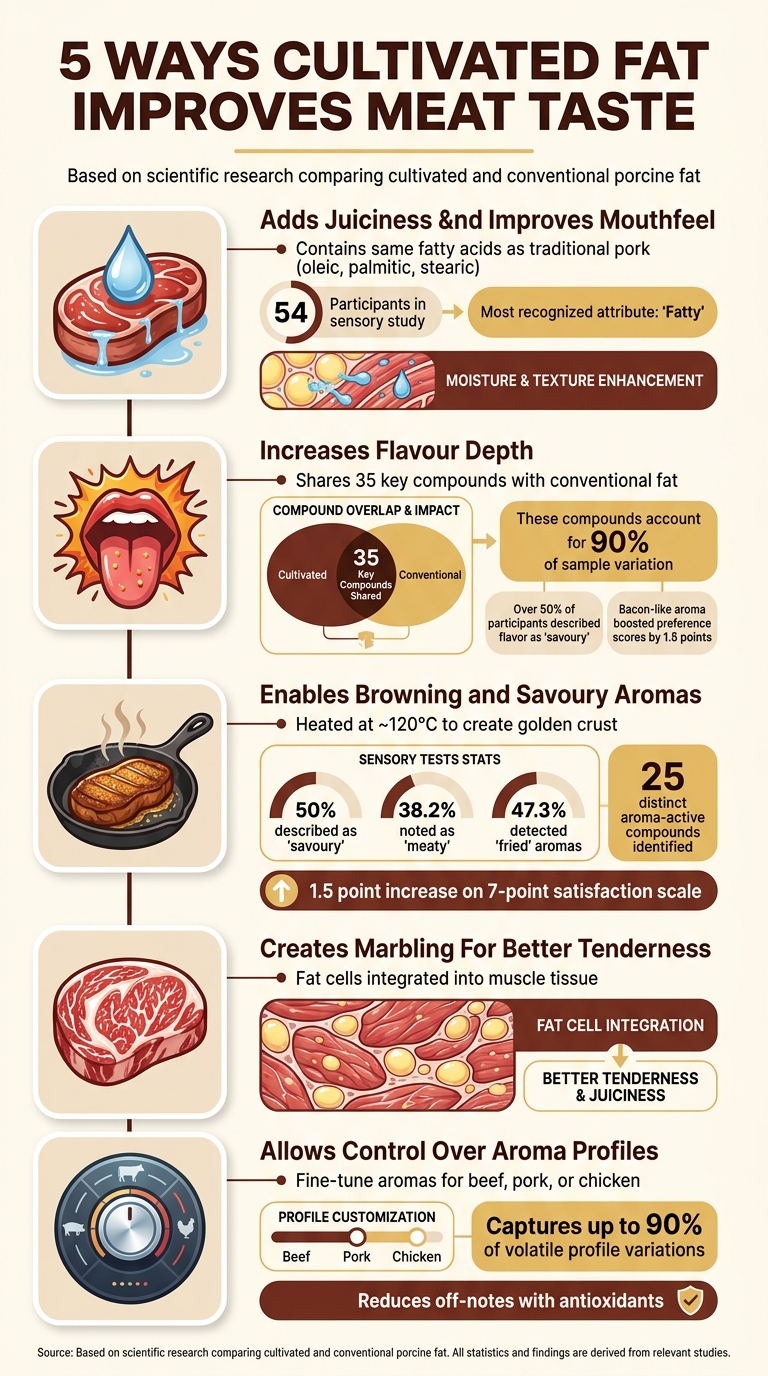
5 Ways Cultivated Fat Improves Meat Taste and Quality
Bioengineers are using fat made from pig cells to make lab-grown meat taste more appealing
sbb-itb-c323ed3
1. Adds Juiciness and Improves Mouthfeel
Fat is what separates a juicy, flavourful steak from a dry, lacklustre one. Cultivated fat brings that essential moisture and rich texture to meat, ensuring it stays succulent and satisfying. It’s especially helpful in improving the texture of other high-protein cultivated meat products, which can sometimes feel dry. This added structure doesn’t just lock in moisture - it makes the entire eating experience more enjoyable.
The magic lies in its fatty acid profile. Cultivated porcine fat contains the same key long-chain fatty acids found in traditional pork - oleic, palmitic, and stearic acid. These are responsible for delivering that familiar, indulgent fatty sensation we associate with pork.
"Recent advances in cellular agriculture have demonstrated the potential for producing cell-cultured adipose tissue, or fat, as a key component in replicating the sensory qualities and nutritional value of meat products." - Scientific Reports [2]
In a sensory study with 54 participants, "fatty" was the most commonly recognised attribute when tasting cultivated fat samples. Even better? The overall liking scores were comparable to those of conventional animal fat [2].
2. Increases Flavour Depth
Beyond enhancing juiciness, cultivated fat plays a crucial role as the main flavour carrier in meat. When heated, it releases volatile compounds that create a rich, authentic meat flavour.
Studies show that cultivated and conventional porcine fats share 35 key compounds, accounting for 90% of the sample variation [2]. This means cultivated fat produces the same lipid-derived volatiles that plant-based proteins just can’t mimic. This chemical similarity directly translates into noticeable sensory advantages.
In early taste tests, more than half of the participants described the flavour as savoury, often highlighting fatty, fried, and meaty notes. A bacon-like aroma also boosted overall preference scores by 1.5 points [2].
"These findings provide valuable sensory evidence supporting the viability of cell-cultivated adipose tissue as a flavour component of meat alternatives, substituting for conventional animal fat." - Scientific Reports [2]
Unlike traditional meat, where flavour can vary depending on the animal's conditions, cultivated fat offers a consistently deep and reliable flavour profile. This level of control opens the door to exciting advancements in cultivated meat products.
3. Enables Browning and Savoury Aromas
Cultivated fat plays a key role in creating that golden crust and mouth-watering aroma we associate with well-cooked food. When heated - typically around 120°C - fatty acids like oleic, palmitic, and stearic acids break down. This reaction, combined with other ingredients, produces savoury, roasted flavours through processes like thermal degradation and lipid oxidation [2]. The result? A visually appealing crust paired with rich, savoury aromas that perfectly complement the enhanced juiciness and flavour depth discussed earlier.
Sensory tests reveal that cultivated pork fat excels in delivering these qualities. For example, 50% of participants described it as "savoury", 38.2% noted it as "meaty", and 47.3% picked up on "fried" aromas. When these descriptors were combined with bacon-like or roasted notes, overall consumer satisfaction increased by an average of 1.5 points on a 7-point scale [2].
Researchers have identified 25 distinct aroma-active compounds in cultivated pork fat using advanced analytical techniques [2]. Many of these compounds, particularly sulphur-containing ones and furans, are key to creating the "meaty" and "roasted" characteristics that make cooked dishes so appealing.
"Liking increased when consumers detected 'bacon-like', 'savory', 'roasted', 'sweet', 'meaty', 'fatty', 'fruity', 'animal', 'fried' and 'cheesy' aromas." - Scientific Reports [2]
These findings suggest that cultivated fat can match the browning performance and complex aroma profile of traditional fat, making it a strong contender in replicating the sensory experience of conventional cooking.
4. Creates Marbling for Better Tenderness
Marbling refers to the delicate web of fat interwoven with muscle fibres, giving meat its tenderness and rich flavour. In cultivated meat production, this natural pattern is recreated by integrating cultivated fat directly into the muscle tissue. This approach allows for precise control over the meat's texture.
PDFAT cells are transformed into mature fat cells, known as adipocytes, which are then organised into larger fat clusters to mimic the marbling found in conventional meat [2].
5. Allows Control Over Aroma Profiles
One of the standout features of cultivated fat is its ability to fine-tune aroma profiles with precision. By tweaking the culture media, scientists can guide the development of specific aroma compounds, ensuring the fat delivers scents evocative of beef, pork, or chicken. For instance, adding targeted lipids like Intralipid helps balance fatty acid profiles, creating the desired aromatic qualities [2].
This approach doesn’t just replicate the savoury, roasted, and meaty notes of traditional fats - it enhances them. Studies show that cultivated fat contains key volatile compounds found in conventional fat, making it a strong candidate for flavour customisation [2].
Another advantage is the reduction of unpleasant off-notes. By introducing antioxidants such as ascorbic acid during the cultivation process, lipid oxidation is minimised, which improves the overall aroma quality. Advanced analytical techniques allow researchers to capture up to 90% of volatile profile variations, making it possible to identify and refine the compounds responsible for specific scents [2].
With this level of control, cultivated fat doesn’t just mimic traditional meat aromas; it also offers healthier nutritional profiles while maintaining that enticing sizzle during cooking [1].
Conclusion
Cultivated fat transforms meat in several impactful ways: it boosts juiciness and enhances mouthfeel, deepens flavour through essential fatty acids, promotes browning and savoury aromas during cooking, improves tenderness with marbling, and allows for precise control over aroma profiles. These improvements elevate the dining experience while also opening doors to practical health and environmental gains.
Studies show that cultivated and conventional porcine fat have strikingly similar chemical compositions, with consumers frequently recognising authentic savoury notes during taste tests [2].
Beyond flavour, cultivated fat brings clear health and cooking advantages. It contains less saturated fat compared to traditional animal fat, while offering excellent high-temperature stability - keeping meat tender and full of that signature sizzle. On the environmental side, it offers significant environmental benefits by using far less land and water than conventional livestock farming [2].
The Cultivated Meat Shop provides science-backed insights to help consumers stay informed about these advancements. While products are not yet available in the UK, the platform offers updates and a waitlist for early access. Explore how these innovations are shaping the future of meat at Cultivated Meat Shop.
FAQs
Does cultivated fat taste like real animal fat?
Cultivated fat is designed to mimic the chemical makeup and flavour of traditional animal fat. Sensory evaluations often describe it as "fatty", "fried", and "meaty", suggesting it comes very close to the taste and texture of the real thing. As techniques progress, this likeness is becoming even more refined.
Can cultivated fat be made healthier without losing flavour?
Cultivated fat can indeed be tailored to be healthier without sacrificing flavour. By fine-tuning the fatty acid ratios during production, it's possible to enhance its nutritional value while maintaining the desirable taste and texture that people expect from meat.
Will cultivated fat cook and brown like conventional fat?
Yes, cultivated fat behaves much like conventional fat when it comes to cooking and browning. When exposed to high heat, it undergoes the Maillard reaction, creating that sought-after crispy crust and deep, savoury flavours. That said, you might need to make slight tweaks during cooking because of variations in moisture and fat content.