Cultivated meat could cut farm land use by a lot - but the final result depends on energy, feedstocks, and what people do with the land that is freed.
If I strip the research down to the main point, it looks like this:
- Pasture is the big one. Most livestock land is grazing land, so replacing ruminant meat has the biggest effect.
- Some models show very large cuts. One 2050 scenario found an 83% drop in total agricultural land use, with about 9.6 million km² freed.
- Not all freed land can grow crops. Around 1.3 billion hectares of livestock land are non-arable grasslands.
- Energy still matters. If cultivated meat runs on low-carbon power, land use stays lower. If not, part of the gain shrinks.
- Feedstocks still use cropland. In one full-transition model, glucose for production used about 6% of global arable land.
- Land sparing on paper is not the same as land change on the ground. Climate and nature gains depend on whether spare land is restored, left idle, or kept in farming.
Put simply: the long-term case for cultivated meat is mostly a land story. The product itself matters, but the bigger issue is what happens when livestock numbers fall and huge areas of pasture are no longer needed.
| Main point | What it means |
|---|---|
| Biggest land cut | Less pasture and grazing land |
| Best-case result | Up to 83% less agricultural land in one 2050 model |
| Main limit | Much spared land is not suitable for crops |
| Main condition | Low-carbon energy and food-grade inputs |
| Biggest prize | Rewilding, carbon storage, and habitat recovery |
So when I look at the research as a whole, the answer is simple: cultivated meat could free a huge amount of land over time, but the outcome is shaped less by the meat alone and more by the system around it.
Alternative proteins – what’s in it for farmers & land use?
sbb-itb-c323ed3
How researchers estimate land use effects
How land is modelled changes the answer. In plain terms, it changes how much land seems to be freed up.
Life-cycle assessments and scenario models
LCAs look at land use at the product level, comparing the environmental impact of cultivated meat versus beef. Scenario models look at system-wide land change as adoption grows.
An LCA tracks the inputs needed to produce one kilogram of meat, including electricity use and the land tied to feedstock production. Scenario models take a much broader view. They look at the global food system and simulate what happens over many years as people gradually switch from conventional meat to Cultivated Meat.
That broader lens picks up effects that LCAs can miss. For example, if demand for animal feed crops falls, less cropland may be needed. If livestock numbers drop, pasture land may also be released. That’s a big part of why land-sparing estimates can look so different from one study to another.
The assumptions that shape the results
The results depend heavily on assumptions. Three of them drive much of the gap between studies.
Energy source matters a lot. Grids powered by renewables tend to keep land footprints lower, while grids that rely more on fossil fuels push them up. Even renewables come with a land cost, since wind and solar infrastructure needs space. Still, that land use is far smaller than the pasture land Cultivated Meat could replace.
Feedstock inputs also shape the result. Cells need a carbon source to grow. Most current models assume glucose from maize, which still depends on arable land. In a full transition scenario, glucose production for Cultivated Meat would use roughly 6% of total global arable land [1].
Production scale is the third big factor. Studies based on current lab conditions can end up with very different numbers from studies that model optimised, industrial-scale facilities. Small changes in assumptions about cell density, growth rates, or whether production is food-grade or pharmaceutical-grade can shift both land and energy footprints. Rules matter too, because pharmaceutical-grade processing can use more energy than food-grade processing [2].
Those choices feed straight into the land-reduction figures discussed next.
What the main studies find about land reduction
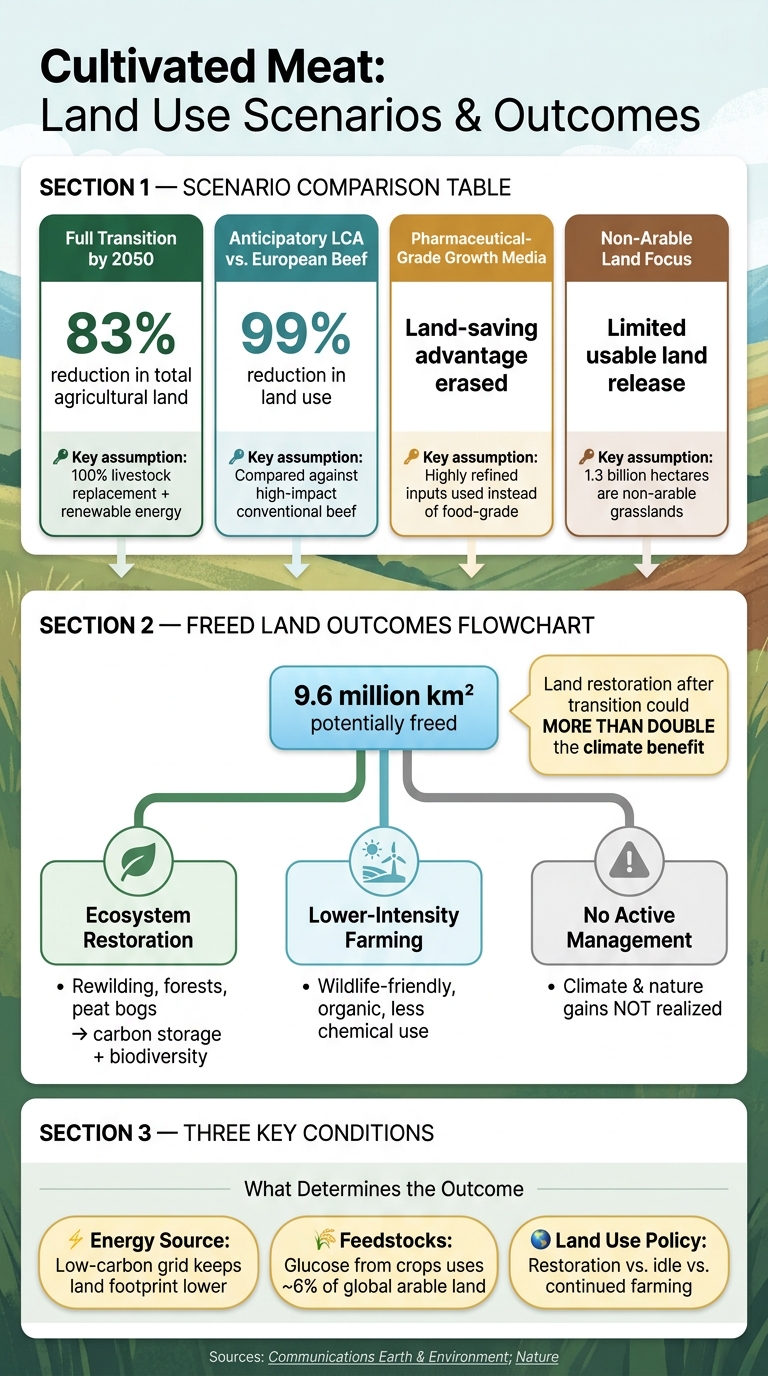
Cultivated Meat Land Use: Key Scenarios & Outcomes Compared
The biggest land saving comes from replacing pasture. Once pasture use drops out of the system, agricultural land demand falls hard. The next step is to ask how much land that could free up if this happened at scale.
Findings from favourable long-term scenarios
The most optimistic projections look at full replacement of conventional livestock by 2050. In that kind of scenario, research published in Communications Earth & Environment found that a full transition could cut total agricultural land use by 83%, freeing about 9.6 million km² for other uses [1].
An earlier anticipatory life-cycle assessment went even further. It estimated a 99% reduction in land use when Cultivated Meat was compared with high-impact European conventional beef production [3].
Those numbers sound dramatic, but they rest on a big assumption: industrial-scale, food-grade production powered mostly by renewables.
That brings up the harder issue. Even if land is spared on paper, how much of it can actually be used for other farming or for restoration?
Findings that show weaker or less certain advantages
Not every study gives such a clean result. Around 1.3 billion hectares of livestock land are non-arable grasslands, which means they cannot simply be switched into crop farming [3]. So while land demand may fall, not all spared land is immediately reusable.
Inputs matter too. If producers use pharmaceutical-grade growth media instead of food-grade options, the higher environmental costs can wipe out the land-saving edge [3].
| Study Scenario | Land-Use Effect | Main Assumption |
|---|---|---|
| Full transition by 2050 | 83% reduction in total agricultural land [1] | 100% livestock replacement; renewable energy powering production [1] |
| Anticipatory LCA (vs. European beef) | 99% reduction in land use [3] | Comparison against high-impact European conventional beef production [3] |
| Pharmaceutical-grade growth media | Can erase the land-saving advantage [3] | Highly refined inputs used instead of food-grade alternatives [3] |
| Non-arable land focus | Limited "usable" land release [3] | 1.3 billion hectares of current livestock land are non-arable grasslands [3] |
Why short-term and long-term results differ
Early-stage Cultivated Meat production runs at small scale and often relies on processes borrowed from pharmaceutical manufacturing. That leads to land-use figures that look very different from those in large-scale, optimised facilities [3]. Put simply, today's pilot systems and tomorrow's industrial systems are not the same thing.
Then there is the next issue: what happens to spared land in practice. It could go to restoration, carbon recovery, or lower-intensity farming.
What could happen to land that is no longer needed
The key issue is what happens to land after it is no longer needed for livestock. Put simply, the big question is how this spared land gets used.
Ecosystem restoration and carbon recovery
The biggest upside is to return spared land to nature through rewilding, nature reserves, forests and peat bogs for carbon storage [4]. A full Cultivated Meat transition (see what is cultivated meat for a primer) could, over about a century, free up at least 80% of existing farmland from agriculture [4].
The carbon gains from that shift could be huge. Research published in Nature found that replacing part of global ruminant meat demand with alternative protein by 2050 could prevent future growth in global pasture area, cut annual deforestation in half, and reduce the CO2 emissions linked to it [5]. That's a major climate gain from a fairly modest change in diet.
But there's a catch. The carbon and biodiversity gains only happen if freed land is actively managed for restoration, not just left sitting there or switched to other intensive uses. So the practical choice is pretty clear: restore the land, or keep it in production.
Lower-intensity farming on part of the freed land
If land isn't restored, some of it could still stay in farming at lower intensity. In other words, not all freed land has to leave agriculture, but it may no longer need to be pushed as hard.
"Since there would be less pressure on the land, there would be less need for chemicals and pesticides and crop production could become more wildlife-friendly." - Chris D Thomas, Director of the Leverhulme Centre for Anthropocene Biodiversity [4]
Organic and wildlife-friendly farming tend to scale poorly because yields per hectare are lower. With less pressure on land, that kind of farming becomes more workable, because every hectare no longer has to deliver the highest possible output [4].
There are limits, though. Much of this land is non-arable grassland, so it cannot simply be turned into cropland [3]. And in some landscapes, removing livestock altogether could affect soil fertility, because animal dung has long added organic matter and nutrients to the land [3].
Conclusion: what the evidence shows overall
Where the evidence broadly agrees
Taken together, the models point the same way: Cultivated Meat could cut land demand sharply at scale. The biggest shift comes from reducing pasture use, which accounts for most livestock land. Some models point to a large fall in total agricultural land by 2050 [1], with the biggest gains linked to replacing ruminant meat.
What remains uncertain
Those gains hinge on three variables: energy, feedstocks, and what happens to land after the transition. Energy source is still a major factor. Without low-carbon power, some of the land savings are offset by the land needed for energy infrastructure [1][2]. Feedstock choice matters too, because crop-based inputs still come with a land cost.
The biggest open question is what happens to land after the transition. The full climate and nature gain only shows up if spared land is restored for carbon storage and biodiversity [6]. Land restoration after transition could more than double the climate benefit by adding carbon sequestration [6]. So yes, the land savings are there. What they mean in practice depends on whether freed land is restored, rewilded, or kept in lower-intensity production.
FAQs
Why is pasture land important in this debate?
Pasture land matters because it makes up most of the agricultural land used for livestock grazing.
If Cultivated Meat cuts the need for that land, large areas could be freed up for ecosystem restoration and biodiversity. That could also improve land-use efficiency and reduce environmental impacts.
Would Cultivated Meat still need cropland?
Yes. Cultivated Meat would cut the amount of cropland needed to grow livestock feed by a large margin, but it wouldn’t remove the need for arable land altogether.
Some farmland would still be needed to produce glucose, often from maize, which is used as a substrate in the production process.
What happens to the land freed by Cultivated Meat?
Land freed by Cultivated Meat could be used mainly for habitat repair and other uses. Research suggests that if it replaces a large share of conventional meat, vast areas now used for grazing and feed crops could be put to work in different ways.
That land might be used to restore habitats, support biodiversity, plant forests for carbon storage, rewild landscapes, protect nature, or grow crops for direct human consumption.