Serum-free media (SFM) is replacing fetal bovine serum (FBS) in cultivated meat production due to cost, ethical, and safety concerns. FBS, derived from bovine foetuses, is expensive, inconsistent, and tied to animal slaughter. SFM, made from defined, non-animal components, is safer, scalable, and aligns better with food production needs. Growth media costs dominate cultivated meat production (95%), making SFM critical for reducing prices.
Key Points:
- FBS Costs: Variable and high due to reliance on cattle industry.
-
SFM Costs: Initially high but decreasing with optimised formulations.
- Mosa Meat SFM: ~£11.10/L
- Believer Meats SFM: ~£0.52/L
- Advantages of SFM: Consistent, safer, and scalable.
- Challenges: Scaling recombinant protein production and reducing costs further.
Quick Comparison:
| Feature | FBS | Serum-Free Media (SFM) |
|---|---|---|
| Origin | Animal-derived (bovine) | Recombinant, plant, microbial |
| Cost per Litre | Variable | £0.52–£57.80 |
| Safety | Risk of contamination | Low risk |
| Scalability | Limited | High |
| Ethical Concerns | Yes | None |
Switching to SFM is reshaping the cultivated meat industry, driving costs down and making production more feasible for large-scale food markets in the UK.
What Are FBS and Serum-Free Media?
Fetal Bovine Serum (FBS): What It Is and How It Is Used
Fetal bovine serum (FBS) is a nutrient-dense liquid derived from bovine foetuses, long regarded as the benchmark for cell culture in biomedical research and early Cultivated Meat development. It contains essential growth factors, hormones, and transport proteins like albumin and fetuin, all of which are crucial for promoting cell growth.
However, FBS has its drawbacks, particularly its high cost. A striking example is the production of the first Cultivated Meat burger, which cost around £210,000 due to its reliance on FBS-based media [3]. These limitations have led to the exploration of serum-free media as a more practical and defined alternative.
Serum-Free Media (SFM): What It Is and What It Contains
Serum-free media (SFM) is a chemically defined substitute for the variable mixture found in FBS. Typically, SFM includes a basal medium, such as DMEM/F-12, combined with recombinant proteins (like insulin, transferrin, and FGF-2) and plant-based or microalgae-derived extracts. Its key advantage lies in its consistency: unlike the unpredictable composition of FBS, SFM offers a transparent and reproducible formulation, which is essential for scaling up food production.
The table below highlights the main differences between FBS and SFM:
| Feature | Fetal Bovine Serum (FBS) | Serum-Free Media (SFM) |
|---|---|---|
| Origin | Animal-derived (bovine foetus) | Recombinant, plant, or microbial |
| Composition | Undefined; varies by batch | Chemically defined; consistent |
| Ethical Status | Raises ethical concerns | Free from animal components |
| Safety Risk | Potential for viruses/prions | Low risk due to controlled formulation |
| Scalability | Limited by cattle industry | High, via industrial fermentation |
| Cost Trend | Volatile and expensive | High now, but expected to decrease with scale |
Why Cultivated Meat Needs Serum-Free Media
The transition to SFM is essential for achieving ethical, scalable, and safer Cultivated Meat production. Ethically, FBS is problematic as it involves extracting components from bovine foetuses, a process tied to the slaughter of pregnant cows. This practice conflicts with the goal of reducing animal suffering - a cornerstone of Cultivated Meat's mission.
FBS also poses safety concerns, as it can carry viruses, mycoplasma, or prions, making it unsuitable for food production under modern regulations. In contrast, SFM's controlled composition significantly reduces these risks.
Scalability is another pressing issue. The global supply of FBS is inherently tied to the cattle industry, which cannot support the demands of large-scale production. On the other hand, SFM's components can be produced through precision fermentation or molecular farming, making it a more reliable option for mass production.
"Developing fully defined and animal-free media is a central goal in cellular agriculture, as it directly influences production costs, regulatory acceptance, and alignment with sustainability claims." - npj Science of Food [1]
Regulatory trends also favour serum-free methods. For instance, GOOD Meat received approval in Singapore in January 2023, and Aleph Farms followed in Israel in January 2024. These milestones highlight the growing acceptance of animal-free processes as the standard for Cultivated Meat production [2].
Dr. Peter Stogios: Low-cost growth factors for serum-free media
Direct Cost Comparison: FBS vs Serum-Free Media
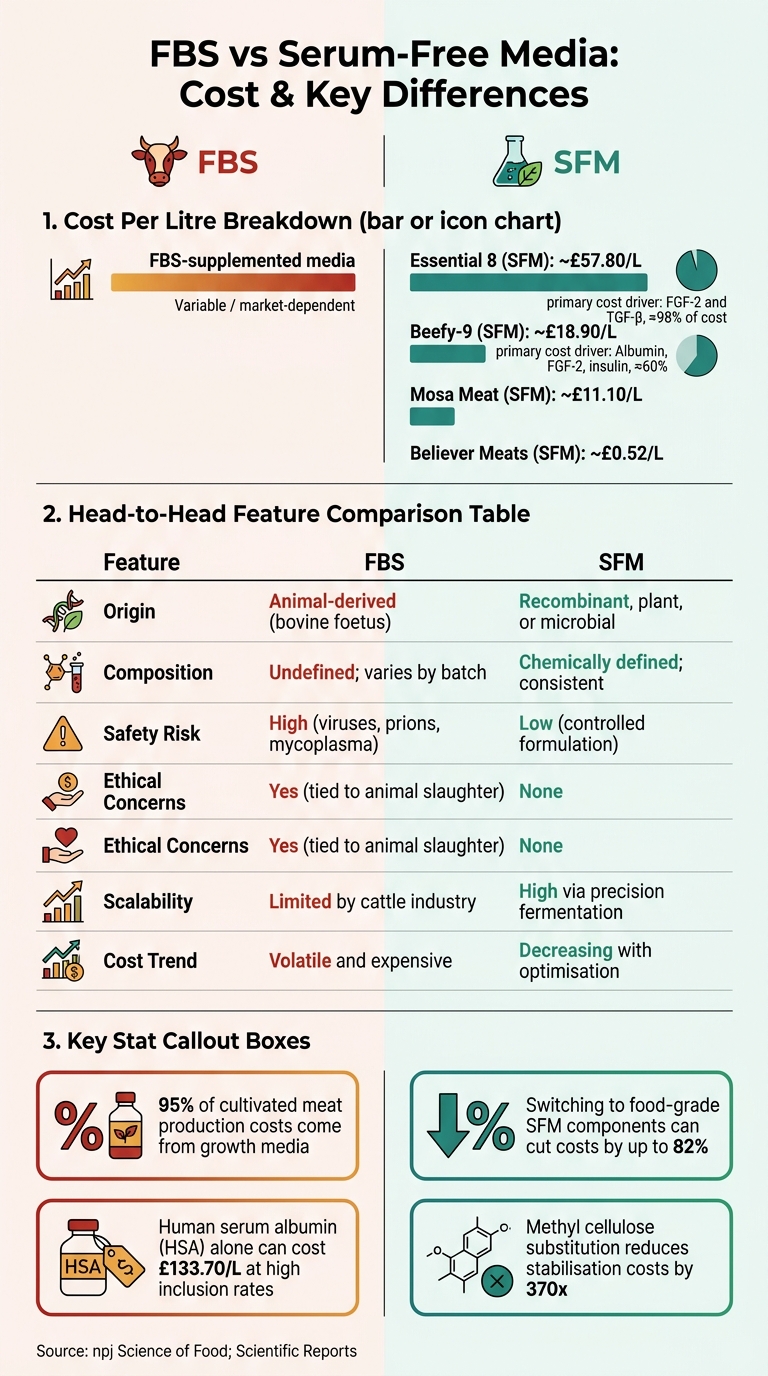
FBS vs Serum-Free Media: Cost & Key Differences in Cultivated Meat Production
How Much Does FBS-Based Media Cost?
FBS is typically used at concentrations between 2% and 20%, with the cost increasing as the concentration rises [1]. Its price is also subject to fluctuations in the market. In comparison, serum-free media (SFM) have a wide price range, depending on their specific formulation.
How Much Does Serum-Free Media Cost?
The cost of serum-free media can vary significantly based on the formulation. For instance, Essential 8 medium costs approximately £57.80 per litre, with nearly 98% of this cost attributed to two components: FGF-2 and TGF-β [2]. On the other hand, optimised formulations like Mosa Meat's SFM (~£11.10 per litre) and Believer Meats' version (~£0.52 per litre) achieve much lower costs by replacing albumin and fine-tuning nutrient levels [2].
One of the major cost drivers in some formulations is recombinant albumin. For example, in B9 medium, human serum albumin (HSA) costs around £20.16 per litre, making up over 50% of the total media cost. At higher inclusion rates (5 g/L), HSA costs can soar to roughly £133.70 per litre. However, substituting food-grade stabilisers like methyl cellulose can dramatically reduce stabilisation expenses - by as much as 370 times [3]. These examples highlight how optimising formulations can lead to significant savings.
"SFM makes up at least 50% of variable operating costs in cultivated meat manufacturing, mainly due to the use of growth factors (GFs) and recombinant proteins (RPs)." - npj Science of Food [2]
These cost details illustrate the broad disparities between FBS and various SFM formulations.
Cost Comparison Table: FBS vs Serum-Free Media
| Media Formulation | Estimated Cost per Litre | Primary Cost Driver |
|---|---|---|
| FBS-supplemented (2–20%) | Variable; scales with serum inclusion | Fetal bovine serum market price |
| Essential 8 (SFM) | ~£57.80 | FGF-2 and TGF-β (≈98% of total cost) [2] |
| Beefy-9 (SFM) | ~£18.90 | Albumin, FGF-2, and insulin (≈60%) [2] |
| Mosa Meat (SFM) | ~£11.10 | Recombinant proteins and basal media [2] |
| Believer Meats (SFM) | ~£0.52 | Optimised food-grade components [2] |
The stark price differences between the most expensive and least expensive SFM formulations often stem from the choice of proteins and the methods used to produce them. Switching from pharmaceutical-grade to food-grade components can lead to cost reductions of approximately 77%–82% [2].
sbb-itb-c323ed3
Hidden Costs and Long-Term Affordability
When considering the overall affordability of media used in cultivated meat production, it’s essential to look beyond the upfront costs. Factors like consistency, supply chain reliability, and compliance with regulations play a major role in determining the true expenses over time.
Batch Variability and Process Consistency
One of the biggest challenges with FBS (foetal bovine serum) is its undefined composition, which varies significantly from one batch to another. This inconsistency can lead to production failures and delays, ultimately increasing costs.
"Batch-to-batch variability and the risk of contamination with viruses, mycoplasma, or prions further reinforce the need for replacement [of FBS] with recombinant or plant-based alternatives." - npj Science of Food [1]
On the other hand, serum-free media offers a chemically defined formulation. Each component is carefully controlled, ensuring consistent and reproducible results. For manufacturers operating under stringent quality standards, this predictability is a major advantage. The variability issues linked to FBS, combined with its limited availability, only serve to drive costs higher.
Supply Limits and Scaling Up
The supply of FBS is inherently limited, as it depends on the number of pregnant cows slaughtered. This creates a fixed cap on production, making it difficult to scale up when demand increases [3]. For cultivated meat producers looking to expand, this bottleneck presents a serious hurdle.
In contrast, serum-free media components - such as recombinant proteins - are not bound by the same biological constraints. These proteins can be produced through methods like precision fermentation or molecular farming. For instance, plants like tobacco or barley can act as biological factories to produce growth factors, with costs projected to fall to approximately £0.80 per gram [2]. However, scaling up recombinant protein production is no small feat. Replacing just 1% of the meat consumed globally would require millions of kilograms of recombinant albumin - a volume far beyond current industrial capabilities [3]. Meeting this demand will require substantial investment in infrastructure to increase production capacity.
Beyond supply challenges, compliance with regulations and ethical considerations further impacts affordability.
Regulatory and Ethical Factors
The process of collecting FBS introduces significant regulatory hurdles due to the risks of contamination, which complicates approval processes [1].
Serum-free media avoids many of these issues. In July 2024, Meatly, a UK-based company, received regulatory approval from the Animal and Plant Health Agency (APHA) and the Department for Environment, Food and Rural Affairs (Defra) to produce cultivated pet food using serum-free methods [2]. This approval highlights a growing shift towards "animal-component-free" approaches, which are not only ethically preferable but are becoming the expected standard for regulators. For producers, moving away from FBS is increasingly a practical step for bringing products to market. These regulatory advantages also make serum-free media a cost-effective choice for cultivated meat production, ultimately benefiting consumers in the UK.
What Media Costs Mean for Cultivated Meat Prices in the UK
Growth Media as a Major Production Cost
Growth media accounts for a staggering 95% of cultivated meat production costs [3].
"Over 95% of the production costs are attributed to [the cultivation medium]." - Scientific Reports [3]
For cultivated meat to compete with traditional meat, affordable serum-free media is non-negotiable. These costs currently dominate production but hold significant potential for reduction as media technologies improve.
How Serum-Free Media Costs Could Fall Over Time
The cost of serum-free media is already dropping, with clear opportunities for further savings. For instance, switching to food-grade components can slash costs by 82%, lowering basal media costs by around 77% [2].
"Replacing basal medium components with bulk, food-grade, equivalents could reduce basal media cost by 77%." - Liz Specht via npj Science of Food [2]
Companies like Believer Meats and BioBetter are leading the charge in cost reduction. Believer Meats has brought their serum-free medium cost down to just £0.52 per litre by replacing albumin and fine-tuning their cells' nutritional needs [2]. Meanwhile, BioBetter has taken an innovative approach by using tobacco plants to produce growth factors like insulin, transferrin, and FGF2, aiming for a cost of around £0.80 per gram [2]. These advances are paving the way for more affordable production, which will ultimately benefit consumers.
What Lower Media Costs Could Mean for UK Shoppers
As serum-free media becomes more affordable, it directly impacts the price consumers pay. Lower production costs bring cultivated meat closer to price parity with conventional meat. For example, Mosa Meat replaced 99.2% of their basal cell feed by weight with food-grade components, all while maintaining similar cell growth rates [2]. This progress signals a clear path to more accessible pricing at the retail level.
"Advancements in SFM technology will be major drivers for cultivated meat to reach price parity with conventional meat." - npj Science of Food [2]
In the UK, the market is already starting to take shape. Meatly's regulatory approval in July 2024, as mentioned earlier, is a key step forward. As production scales up and media formulations become increasingly efficient, the prospect of cultivated meat being priced alongside conventional options becomes more tangible. Platforms like Cultivated Meat Shop are tracking these developments, keeping consumers informed as the market evolves.
Conclusion: Why Serum-Free Media Matters for Cultivated Meat
At first glance, FBS might seem like the cheaper option, but its limitations - unpredictable supply, variability, and ethical concerns - make it unsuitable for large-scale, sustainable production. On the other hand, serum-free media (SFM) offers a clear and promising path forward. It is chemically defined, consistent, and avoids the ethical and regulatory challenges tied to animal-derived inputs.
Companies like Believer Meats and Mosa Meat have already made strides in reducing costs, showing a steady decline in production expenses. This isn't just theoretical progress - it's laying the groundwork for more accessible and scalable cultivated meat production.
Currently, growth media costs dominate, making up over 95% of production expenses [3]. While this is a significant challenge, it's one that can be overcome. Innovations such as switching to food-grade components, harnessing molecular farming, and using precision fermentation are already lowering costs and boosting scalability.
For UK consumers, these advancements are particularly exciting. The approval of Meatly's cultivated meat in July 2024 highlights the progress being made in the domestic market. As serum-free formulations become more efficient and affordable, the dream of cultivated meat reaching price parity with traditional meat is becoming a reality. This progress underlines why SFM is so crucial.
FAQs
Why is growth media such a big cost in cultivated meat?
Growth media remains one of the most expensive components in cultivated meat production, primarily due to the high cost of growth factors and recombinant proteins. These proteins are costly to manufacture because of the intricate processes involved and their tendency to degrade quickly. In the past, the use of animal-derived ingredients, such as Fetal Bovine Serum (FBS), further inflated costs. However, the shift towards serum-free media is helping to lower expenses while also resolving ethical issues tied to animal-based products.
Why are some serum-free media much cheaper than others?
The price variation in serum-free media largely comes down to efforts aimed at minimising the use of costly ingredients, such as growth factors and recombinant proteins. A common approach is substituting pharmaceutical-grade materials with food-grade alternatives, which can lead to substantial savings. Another cost-cutting measure involves removing expensive growth factors altogether. Moreover, producing growth factors internally - using techniques like molecular farming - can bring down costs even further. These strategies make certain serum-free media options much more budget-friendly compared to traditional formulations.
How soon could cheaper serum-free media lower UK retail prices?
Cheaper serum-free media could play a key role in making cultivated meat more affordable for consumers in the UK. With projections suggesting that media costs could fall to under £1 per litre, alongside reductions in overall production expenses, cultivated meat might rival the price of traditional meat by the late 2020s or early 2030s.