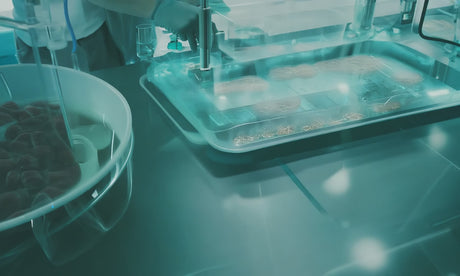
Cultivated meat is still too expensive for the weekly shop, and AI is one of the main tools companies are using to cut the bill.
From what I’ve read here, the cost problem comes down to three things:
- media is pricey
- bioreactors waste money when batches go wrong
- development takes too long and costs too much
AI helps by finding lower-cost media mixes, keeping bioreactors stable in real time, and reducing lab trial work with digital twins and automated testing. That matters because media can use 8 to 41 litres per kg, some serum-free ingredients make up 95–99% of media cost, and AI-led process control in related bioprocessing has been linked to about 25% higher yield, about 30% lower running costs, and up to 40% lower cost per batch.
Here’s the short version in plain English:
- Price is the main barrier keeping cultivated meat out of UK supermarkets
- Media is one of the biggest cost centres, especially growth factors and proteins
- Bioreactor failures are expensive, with large systems costing from £0.8 million to many millions
- Slow lab testing delays lower prices
- AI cuts waste, failed batches, and lab time
- If costs fall towards £5–£10 per kg, cultivated meat gets much closer to normal retail pricing
For me, the main takeaway is simple: AI does not solve everything, but it can cut some of the biggest production costs that still keep cultivated meat off most shelves.
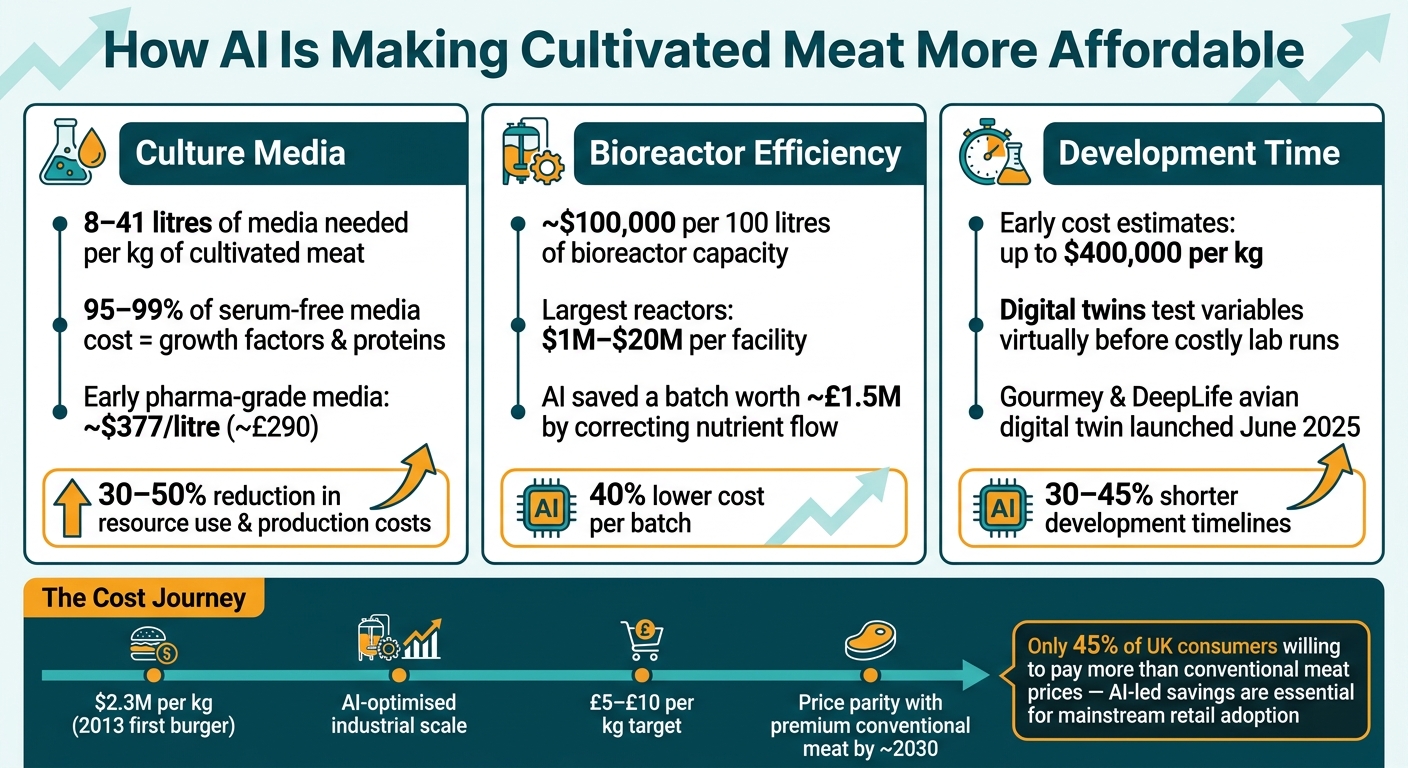
How AI Cuts Cultivated Meat Costs: Key Numbers at a Glance
How AI Is Fueling The Lab-Grown Meat Industry
sbb-itb-c323ed3
The Main Cost Drivers Behind Cultivated Meat
Three cost drivers sit at the centre of Cultivated Meat costs: culture media, bioreactors and development time.
Culture Media Is One of the Biggest Expenses
Culture media is the nutrient-rich liquid that keeps cells alive and growing. For a long time, it has been one of the biggest cost drivers.
Early formulations relied on foetal bovine serum (FBS), which could account for more than 60% of media costs.[13][14] When producers shifted to serum-free options, they didn’t get rid of the cost problem. They just changed its shape. The growth factors and proteins used to replace FBS - such as FGF‑2, TGF‑β, recombinant albumin, and insulin - can make up over 95–99% of a serum-free medium's cost.[9][10][11][12] These ingredients are expensive to produce and hard to keep stable.[11][2]
And the scale makes every pound matter. At 8 to 41 litres of media per kilogram, even a small drop in cost per litre can change the maths in a big way.[15][1] Early pharma-grade media was estimated at around $377 per litre (roughly £290),[12][16] which made affordable retail pricing hard to imagine.
That’s why media is one of the first places AI can cut costs.
Bioreactor Inefficiency Leads to Waste and Lost Money
Various bioreactor designs serve as the vessels where cells grow at scale. If control slips, the waste adds up fast: more media lost, more electricity used, and more time gone.
Survey data suggest roughly $100,000 for every 100 litres of bioreactor capacity.[4] Estimates for the largest reactor in a second commercial facility range from $1–3 million to $18–20 million.[4] With that kind of spend, one contaminated or unstable batch isn’t a minor issue. It’s a costly setback. Poor control can lower cell density, cut yield and push up cost per kilogram.
This is the next place where AI can reduce waste.
Slow Trial-and-Error Testing Delays Affordable Products
Traditional development often depends on one-variable-at-a-time testing. That approach is slow, costly and hard to scale.
Early models estimated costs as high as $400,000 per kilogram[12][16][7][3] - driven in large part by expensive media and the amount of testing needed to refine the process. Every extra week slows the path to lower prices. These are the bottlenecks AI can target most directly.
These bottlenecks are exactly where AI starts to change the economics.
How AI Cuts Costs During Production
AI cuts costs by going after the three biggest choke points in production: media, bioreactor control, and development time.
AI-Optimised Culture Media Lowers Ingredient Costs
Researchers have used AI to optimise Cultivated Meat media across cost, growth, and environmental impact, while reaching high prediction accuracy. That means fewer wasted experiments and a faster route to media formulations that are worth testing in the lab. [5]
Reviews of AI-guided media optimisation report 30–50% reductions in resource use and production costs in some contexts. [6] That helps on two fronts at once:
- lower ingredient costs per litre
- fewer physical trials
Both make a difference when the goal is to bring Cultivated Meat closer to a price point a UK supermarket might actually look at seriously.
The same basic idea carries over to bioreactor control.
Smarter Bioreactor Control Prevents Failed Batches
Inside a bioreactor, conditions such as temperature, oxygen, pH, and nutrient levels have to stay within tight limits. Once those drift too far, cell health drops off fast, and a whole batch can be lost.
AI control systems track sensor data all the time and adjust conditions in real time before small issues turn into costly failures. In related bioprocessing, this kind of system has been linked to 40% lower cost per batch through fewer failed runs, and individual interventions have reportedly saved batches worth around £1.5 million by correcting nutrient flow before failure occurred. [17][18]
That matters because every failed batch burns through more than cells. It also wastes media, energy, labour, and production time. Fewer failures mean steadier output and less money going down the drain.
AI also helps cut the time and cost of development itself.
Automation and Digital Twins Speed Up Development
One of the biggest shifts is moving away from pure trial-and-error in the lab and towards virtual testing first. Digital twins - computational models built from real experimental data and physics-based modelling - let producers test process changes before paying for physical runs.
In June 2025, Gourmey and DeepLife announced an avian digital twin designed to fine-tune media composition and metabolic efficiency before expensive lab experiments, linking the approach to its cost-competitive production ambitions. [19][20][21]
AI speeds up development by testing more variables at once, cutting manual work, and ruling out weak options before they ever reach the bench. Paired with robotics and automated imaging, it can also take care of repetitive lab tasks, assess cell quality non-destructively, and flag problems earlier.
A 2024 review found that combining multi-source Bayesian optimisation, digital twin modelling, and AI-guided experiment design can shorten development timelines by 30–45% while improving batch consistency. [6] Lower R&D spend feeds directly into lower production costs, which is one of the main steps towards lower shelf prices through economies of scale.
What Lower Production Costs Could Mean for UK Shoppers
Lower Costs Can Bring Prices Down and Widen Availability
When production costs drop, shop prices usually follow.
Cultivated Meat began at an almost unbelievable cost. The first cultured beef burger in 2013 came in at about $2.3 million per kg. Techno-economic modelling suggests that, at industrial scale, costs could fall to around £5–£10 per kg. That would put it on a path towards price parity with premium conventional meat by around 2030.[6][8][24]
That matters because shoppers have limits. A rapid evidence review for the Food Standards Agency found that most UK consumers are unwilling to pay more for Cultivated Meat than for conventional meat. In one study, only 45% of UK participants said they would pay more.[25] If AI-led savings make their way through the supply chain and onto the shelf, Cultivated Meat starts to look less like a high-end curiosity and more like something that could fit into a normal weekly food shop.
Lower costs per unit can also make retailers more willing to stock it more often. If the numbers work better, the risk of giving it shelf space drops too.
For price-sensitive flexitarians, that shift could be a big deal. A lower price turns Cultivated Meat from a one-off purchase into something people might pick up as part of a regular shop.
Consistent Production Builds Consumer Trust
Price is only one part of it. Even if the cost is right, Cultivated Meat still has to taste and feel the same every time. That’s how new food moves from “I’ll try it once” to “I’ll buy it again”.
Early production sites can face real variation in cell growth rates, media performance and bioreactor conditions. Small changes there can lead to subtle differences in the final product. AI tools, including real-time predictive control and digital twin modelling, are used to steady those conditions before issues grow into bigger problems. The payoff is fewer failed batches, a steadier supply and products that deliver the same taste and texture more often.[6][8]
For UK shoppers, that kind of consistency is what helps build trust. Research keeps showing that people are cautious about novel food technologies unless products can show reliable taste, texture and safety over time.[22][23] There’s also a plain retail issue here: fewer production problems can mean fewer out-of-stock gaps, which matters if a supermarket is thinking about a regular listing.
How Cultivated Meat Shop Helps Consumers Follow Progress
Cultivated Meat Shop tracks these changes for UK consumers with clear articles, product previews and waitlist sign-ups.
Conclusion: How AI Could Make Cultivated Meat More Affordable
Cultivated Meat is still expensive, and the reasons are pretty clear: media costs are high, bioreactor control is hard, and development takes time. Put all that together, and cheap Cultivated Meat is still out of reach for most shoppers.
This is where AI starts to matter in a practical way. It tackles each bottleneck head-on. Machine-learning models can spot lower-cost media formulations without hurting cell performance. Real-time predictive control helps keep bioreactors in the right operating range, which cuts down on failed batches. And digital twins let companies run hundreds of virtual experiments instead of testing every idea in the lab, which saves time and cuts related costs. In simple terms, AI shifts the economics by cutting waste, reducing failures, and shortening development cycles.
That can lead to lower shelf prices and products that are more consistent from batch to batch.
For UK shoppers, lower production costs could mean more products appearing on retail shelves. At the same time, AI-led consistency should help Cultivated Meat taste and feel more dependable each time people buy it. AI isn't a quick fix. Companies still need to build factories, meet UK regulatory requirements, and win consumer trust. Even so, AI-enabled optimisation is becoming central to making Cultivated Meat more affordable and more consistent. For UK consumers, that points to a shorter route from novelty to everyday food. Cultivated Meat Shop continues to track this progress, helping UK consumers understand what these technical advances mean for the future of meat on their plates.
FAQs
Why is Cultivated Meat still so expensive?
Cultivated Meat is still expensive for one big reason: growth media can account for more than 95% of production costs.
That’s a huge share of the bill. For years, prices stayed high because producers relied on pharmaceutical-grade ingredients and growth factors, which are costly to source at scale. The good news is that this is starting to shift. Bulk, food-grade options and serum-free media are helping bring costs down.
There’s more to it than media, though. Producers also face high energy use because bioreactors need tight control over conditions such as temperature and other process settings. On top of that, scaling production is hard. Making small batches in a lab is one thing; producing large volumes at a price people will accept is a very different job.
How does AI reduce production costs?
Artificial intelligence can cut Cultivated Meat production costs by improving bioprocessing and trimming energy use.
By working through large trial datasets, it helps researchers spot the best conditions for cell growth and cell density much faster. That means less trial and error, which saves both time and money.
It can also use real-time operational data to fine-tune nutrient delivery, oxygen supply and media composition. The result is less waste and better efficiency across production.
On top of that, AI-driven energy management can reduce electricity use and bring down overall production costs.
When could Cultivated Meat reach supermarket prices?
Cultivated Meat is edging closer to supermarket price parity. Industry forecasts and progress in production suggest it should become more affordable by 2030, and some estimates say it may hit the mainstream within the next few years.
What’s pushing prices down? A few things are doing the heavy lifting: AI-led process optimisation, cheaper food-grade media, and continuous manufacturing.
Put simply, the tech is getting better, and the maths is starting to work.