What does cultivated meat taste like? It’s made from animal cells, so it tastes like meat - beef, chicken, or pork. But the way it’s grown means some subtle differences. For example, cultivated meat often has less of the “bloody” taste found in red meat due to lower myoglobin levels. Fat content, seasoning, and cooking methods also influence the flavour and texture, which can be adjusted during production to suit different preferences.
Key points:
- Flavour: Similar to meat but slightly less complex due to differences in how it develops aroma precursors.
- Fat: Producers can control fat levels, even exceeding those in conventional meat, for tailored richness.
- Texture: Advanced techniques replicate the chewiness and structure of meat, though whole cuts are harder to perfect.
- Cooking: High-heat methods like frying or grilling enhance flavour through the Maillard reaction.
Cultivated meat is still evolving, but blind taste tests often show it’s hard to tell apart from conventional meat. As production improves, expect even closer matches in taste and texture.
What Influences the Taste of Cultivated Meat?
Flavour Profile
Cultivated Meat offers the authentic taste of beef, chicken, or pork without the need for botanical extracts or artificial flavourings. However, it develops flavour differently compared to traditional meat.
In conventional meat, flavour complexities are enhanced by post-mortem metabolism, which generates aroma precursors [3]. Cultivated Meat skips this process, resulting in a slightly altered flavour profile. Additionally, because its muscle tissues are grown in oxygen-rich conditions, they tend to have lower levels of myoglobin. This not only gives the meat a paler appearance but also reduces the "bloody" taste often associated with red meat [3].
Interestingly, during industry events, many consumers have noted an authentic "real meat" aftertaste in Cultivated Meat. This similarity to traditional meat opens the door to further refining its taste, particularly through fat content.
How Fat Affects Taste
Fat plays a crucial role in giving meat its flavour and juiciness. In the case of Cultivated Meat, producers can fine-tune fat content by modifying the concentration of insulin and fatty acids during the cell cultivation process [1][8].
In May 2024, researchers from Shandong Agricultural University and Huazhong Agricultural University successfully created cultivated chicken with varying fat levels - ranging from low to high fat content, even achieving fat levels two to three times higher than those in conventional chicken [1][8]. This ability to adjust fat content allows producers to create meat with tailored richness and texture.
Another study in July 2024 focused on cultivated pork fat, identifying 109 volatile compounds, 35 of which were also present in conventional pork. During consumer testing with 55 participants, cultivated fat scored similarly to traditional pork belly in terms of "meaty" and "savoury" aromas, with no notable difference in preference [10].
| Fatty Acid | Flavour Contribution | Presence in Cultivated Meat |
|---|---|---|
| Oleic Acid | Adds richness and a smooth texture | High; comparable to conventional meat [10] |
| Palmitic Acid | Enhances the "meaty" flavour | High; found in pork and chicken [10] |
| Hexanoic Acid | Produces a fatty, cooked aroma | Present in cultivated pork [10] |
These intrinsic flavours provide a solid base, which can be further enhanced through seasonings.
Seasoning and Marinades
Like traditional meat, Cultivated Meat responds well to seasonings such as salt, pepper, herbs, and spices, which can elevate its natural taste. Early prototypes often relied on heavy seasoning to boost flavour.
Looking ahead, researchers are working on advanced flavouring techniques. For instance, in July 2024, Milae Lee, a biomolecular engineer at Yonsei University in Seoul, developed a hydrogel scaffold infused with furfuryl mercaptan. This compound mimics the Maillard reaction, releasing savoury, browned aromas when heated to 150°C [7][5].
"To our knowledge, it's the first approach to regulate the flavour properties of cultured meat." [7]
This innovation could reduce the need for excessive seasoning in the future, allowing the natural taste of Cultivated Meat to take centre stage.
Texture and Mouthfeel
Replicating Meat Textures
One of the toughest hurdles in crafting Cultivated Meat is nailing the texture. Traditional meat owes its signature chew and bite to a complex mix: about 90% muscle fibres, 10% connective tissue, all held together by a network of blood vessels and fat [11].
To replicate this, Cultivated Meat producers use edible scaffolds - three-dimensional frameworks made from materials like gelatin, alginate, or collagen. These scaffolds provide a structure for muscle cells to attach to and grow into the long, thin fibres that resemble natural meat [12]. In October 2019, a team at Harvard SEAS, led by Professor Kit Parker, showcased an innovative approach. They used immersion Rotary Jet-Spinning to grow rabbit and cow muscle cells on edible gelatin scaffolds, successfully mimicking the texture of natural meat fibres [12].
"Everything we have learned about building organs and tissues for regenerative medicine applies to food: healthy cells and scaffolds are the building substrates, the design rules are the same." - Kit Parker, Harvard SEAS [12]
However, creating whole-muscle cuts presents a bigger challenge, mainly due to the difficulty of distributing nutrients and oxygen evenly. But cutting-edge techniques are making headway. In January 2025, researchers from Spiber Inc. and Keio University developed a 3D needle punching method to integrate protein fibres into a ground pork analogue. This approach significantly enhanced the texture, with 1% added wet-spun protein fibres increasing springiness by 45%, while 5% raised hardness by 331% [13].
These advancements are helping researchers better understand how to replicate the textures of various meat types.
Texture Differences Between Meat Types
Different meats come with their own textural challenges. Processed products like sausages and burgers are generally easier to replicate because their production naturally breaks down the muscle structure. For instance, studies comparing Cultivated Meat sausages with commercial Frankfurt-style sausages found no significant difference in hardness [11].
Chicken, on the other hand, has shown promising results. In 2023, a study led by L. Pasitka tested a hybrid product combining plant protein and cell-cultivated chicken with 30 participants. The feedback was overwhelmingly positive, with 67% preferring the cultivated hybrid over a purely soy-based alternative, noting its striking similarity to conventional chicken [9, 11]. Similarly, trial products from UPSIDE Foods, grown in California bioreactors, received simple but telling feedback: "It tastes like chicken" [4].
Beef and pork are trickier due to their denser muscle structure and higher fat content. For pork, researchers have found that jackfruit-based scaffolds can enhance the "meat-like" texture and appearance by over 8% compared to standard textured soy protein scaffolds [2]. When it comes to beef, texture often hinges on fat content. Consumer tests suggest the best sensory results occur when the product contains around 36% fat [14].
These fine-tuned textural details are essential for delivering the authentic experience that Cultivated Meat aims to provide.
I Tried Cultured Meat: Is It The Future of Food?
sbb-itb-c323ed3
How Cooking Methods Affect Taste
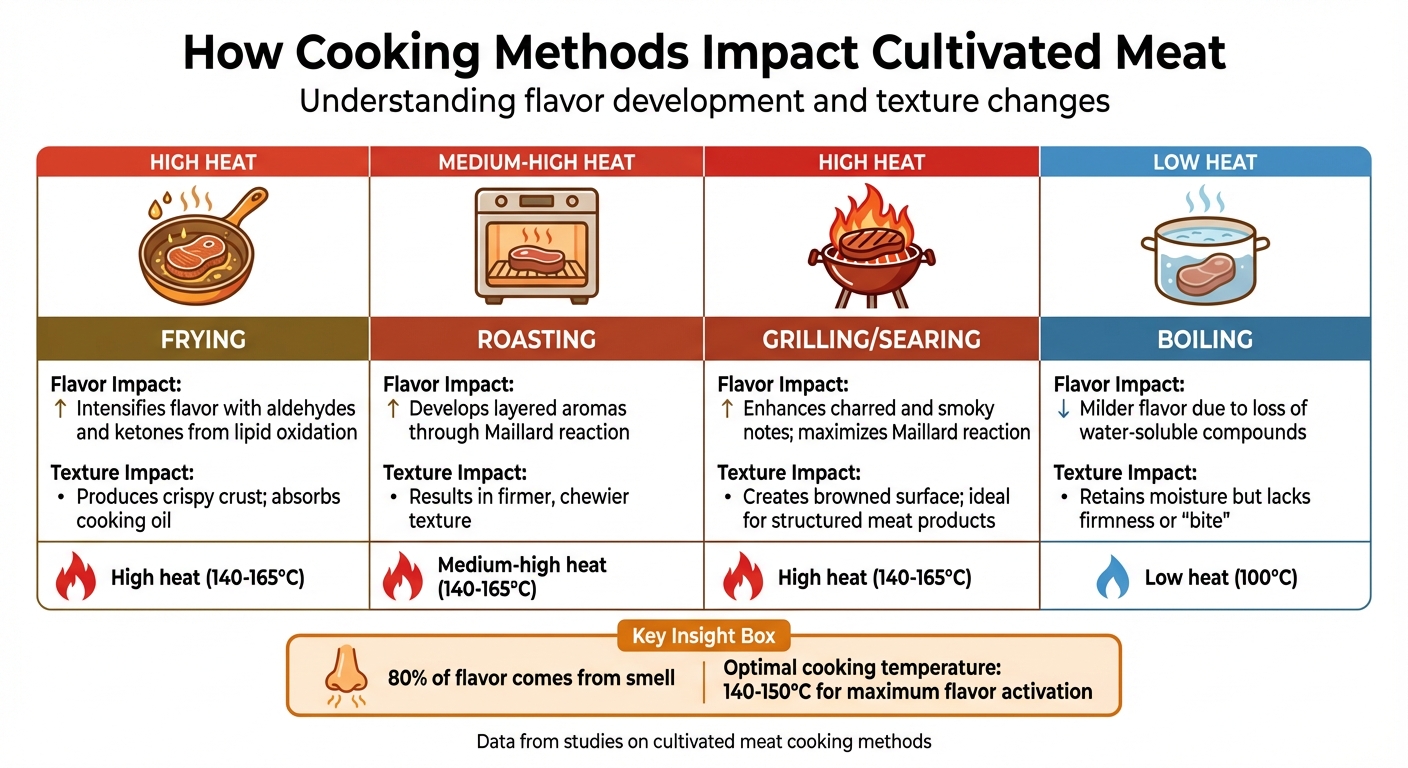
How Cooking Methods Affect Cultivated Meat Flavor and Texture
When it comes to Cultivated Meat, the way you cook it plays a big role in shaping its flavour and texture. Just like with conventional meat, the cooking method triggers specific chemical reactions that produce the savoury, roasted aromas we associate with a satisfying meal.
The two main chemical processes responsible for flavour during cooking are the Maillard reaction (a reaction between amino acids and sugars) and lipid degradation (the breakdown of fats) [17]. Cultivated Meat depends on heat to activate its flavour precursors, which include amino acids, fatty acids, and heme iron [16].
"Heme iron is essential for the flavour development during the cooking... because the iron in the heme protein is kind of a kick starter for all different types of chemical reactions, and these chemical reactions then generate all of these flavour compounds." - Lutz Grossmann, Assistant Professor, University of Massachusetts Amherst [16]
Cooking methods like grilling, frying, and roasting, which use high heat, are particularly effective at triggering the Maillard reaction, typically occurring between 140°C and 165°C [19][20]. These methods also promote lipid degradation, producing compounds like aldehydes, ketones, and furans that contribute to rich and complex flavours [15]. On the other hand, techniques such as boiling or steaming lead to milder flavours and softer textures, as water-soluble compounds are lost, and fat oxidation is minimised [15]. These reactions form the foundation for understanding how to cook Cultivated Meat effectively.
Best Cooking Techniques
Searing and frying are excellent choices for maximising flavour. These methods intensify the Maillard reaction, creating a browned, crispy exterior. A recent study even showed that incorporating engineered aromatic compounds into the meat scaffold can activate roasted beef aromas at 150°C [19].
"Research suggests that when it comes to taste, the smell is responsible for 80% of flavour." - Tessa Wiles, Content Editor, Informa Markets [19]
Grilling takes it a step further by adding smoky and charred notes, making it ideal for products designed with specific aromatic compounds that activate under high heat. Roasting, on the other hand, is perfect for longer cooking times, allowing for deeper flavour development through lipid oxidation [20].
For maintaining moisture, shorter, high-intensity cooking or finishing in the oven can help. Early prototypes of Cultivated Meat, which may lack intramuscular fat, are prone to drying out if overcooked [17]. For leaner versions, mixing in cultivated fat or plant-based oils can enhance both juiciness and flavour through lipid degradation [17].
| Cooking Method | Impact on Flavour | Impact on Texture |
|---|---|---|
| Frying | Intensifies flavour with aldehydes and ketones from lipid oxidation [15]. | Produces a crispy crust; absorbs cooking oil [15]. |
| Roasting | Develops layered aromas through the Maillard reaction [17]. | Results in a firmer, chewier texture [15]. |
| Grilling/Searing | Enhances charred and smoky notes; maximises Maillard reaction [19][20]. | Creates a browned surface; ideal for structured meat products. |
| Boiling | Milder flavour due to loss of water-soluble compounds [15]. | Retains moisture but lacks firmness or "bite" [15]. |
Adjusting Recipes for Cultivated Meat
To get the best results, recipes may need slight tweaks to suit the unique properties of Cultivated Meat.
Most current Cultivated Meat products are hybrids, combining animal cells with plant-based binders. For example, cultivated chicken products available in Singapore contain about 73% real chicken cells, with the rest made up of plant-based ingredients [6]. Cooking these products is similar to preparing high-quality plant-based alternatives, where attention to moisture levels and cooking times is key.
Temperature matters. Cooking at 140°C to 150°C ensures that flavour precursors and any engineered aromatic compounds are fully activated [19]. If the meat has a neutral flavour, marinating it with amino acids or fatty acids beforehand can help kick-start flavour development during cooking [16].
For unstructured products like burgers or nuggets, binders such as breadcrumbs, egg white powder, or plant-based alternatives can help maintain their shape during high-heat cooking [17]. Commercial prototypes have shown that with the right techniques, Cultivated Meat can mimic the texture and flavour of traditional poultry [17][18].
The fat content in Cultivated Meat is highly customisable since muscle and fat cells are often grown separately. Some products can have 2–3 times the fat content of conventional meat, while others may be leaner [8][6]. If you're working with a leaner product, adding fats or oils during cooking can prevent dryness and boost the flavour.
"We're trying to optimise it for the sensory and consumer experience: taste, texture, flavour profile, cost." - Josh Tetrick, CEO, GOOD Meat [6]
What to Expect in the Future
The future of Cultivated Meat is shaping up to be an exciting journey as producers refine their ability to control flavour, texture, and nutrition at the cellular level. Unlike traditional meat production, this technology allows for precise adjustments, paving the way for products that align with evolving consumer tastes and preferences.
Tailored Flavour Possibilities
Advancements in Cultivated Meat are opening doors to customising flavour like never before. By fine-tuning the balance of muscle, fat, and connective tissue, producers can create meats with personalised flavour profiles. This builds on existing methods that adjust fat content and aroma precursors, taking customisation to a whole new level.
In May 2024, researchers Tongtong Ma, Ruimin Ren, and Jianqi Lv from Shandong Agricultural University developed a groundbreaking protocol using chicken fibroblasts within a 3D hydrogel scaffold. This approach allowed them to produce meat with adjustable fat levels, significantly enhancing lipid triglyceride content beyond conventional standards [1][8].
But it’s not just about fat. By July 2024, a study led by M. Lee and published in Nature Communications revealed how Cultivated Meat could be engineered to release specific "beefy" compounds when cooked at high temperatures [5]. Further control over the growth environment is also improving meat texture [21].
Looking ahead, we could see meat products tailored to individual tastes, with options for customised fatty acid profiles or enhanced nutritional content. For instance, UPSIDE Foods - one of the first companies to receive U.S. FDA approval to sell cultivated chicken in June 2023 - has hinted at exploring nutrient personalisation in their future offerings [1][6]. Imagine ordering meat with just the right balance of flavour intensity, fat distribution, or even added vitamins to suit your dietary needs.
Supporting Consumers Through Cultivated Meat Shop
As these advancements unfold, consumers will need reliable information to navigate this new world of Cultivated Meat. That’s where the Cultivated Meat Shop steps in. As the first consumer-focused platform dedicated to this emerging industry, it bridges the gap between cutting-edge technology and everyday shoppers.
The platform provides science-backed insights into how Cultivated Meat is produced, what it tastes like, and how it stacks up against traditional meat. While these products aren’t yet available for purchase in the UK, Cultivated Meat Shop offers product previews, waitlists, and updates to keep consumers informed about when they might hit the shelves.
A notable example of public engagement took place in June 2024, when UPSIDE Foods hosted the "Freedom of Food Pop-Up" event in Miami, Florida. During the event, CEO Dr Uma Valeti and Chef Mika Leon served cultivated chicken tostadas to 75 attendees. Ethnographic analysis revealed that 19 participants were driven by political and ethical curiosity, and the event succeeded in demystifying the technology for many onlookers [9].
In the UK, Cultivated Meat Shop plays a crucial role in preparing consumers for this shift. By offering clear, transparent, and evidence-based information, it helps build trust and understanding. When Cultivated Meat becomes available, shoppers will not only know what to expect but will also have the confidence to explore options tailored to their exact preferences. Whether it’s the perfect flavour profile or enhanced nutritional benefits, the future of meat is set to be as diverse as individual tastes.
Conclusion
Cultivated Meat offers a taste, texture, and aroma that closely align with traditional meat. Its flavour is shaped by factors like fat content, amino acid profiles, and the scaffolds used during production. When prepared and cooked well, any differences are often so subtle that most people wouldn’t notice.
Blind taste tests consistently highlight this similarity. For instance, in January 2022, Master Chef judge Michal Ansky sampled unseasoned cultivated chicken from SuperMeat and mistakenly identified it as conventional meat. She even remarked that it had a richer, more "chickeny" flavour[22]. Similarly, in January 2023, Associated Press reporter JoNel Aleccia described cultivated chicken from Upside Foods as having a "light and delicate" taste and a "tender texture, just like any chicken breast I'd make at home"[23].
"It's one of the only times in my life that I'm really happy that I was wrong... because it's about time." - Michal Ansky, Gastronome and Master Chef Judge[22]
While slight variations may arise due to production techniques or cooking methods, advancements in flavour and texture science are steadily closing these gaps. Innovations like "switchable" flavour compounds, which release meaty aromas when heated to 150°C[7], are paving the way for even more precise taste control.
These developments underscore the potential of Cultivated Meat as a genuine alternative to conventional options. As it enters the market, platforms like Cultivated Meat Shop aim to guide UK consumers through this emerging category. By offering science-based insights, product previews, and waitlist access, they ensure shoppers are ready to embrace this ethical, sustainable, and delicious new choice.
FAQs
Does cultivated meat taste different from traditional meat?
Cultivated meat aims to replicate the taste of traditional meat, though early samples hint at slight differences. Many tasters find it to be milder, lacking the bold, fatty flavours typical of conventional meat. This is largely because cultivated meat doesn’t contain intramuscular fat or undergo cooking reactions like the Maillard effect, which contribute to the rich flavour of traditional cuts.
That said, scientists are making strides to close this flavour gap. By simulating natural processes, they’re working on methods to boost the savoury, juicy qualities of cultivated meat. If you’re curious about seasoning, cooking tips, or the latest developments, the Cultivated Meat Shop provides plenty of resources to explore.
Can the fat content in cultivated meat be adjusted to suit preferences?
Cultivated meat offers the unique ability to adjust its fat content during production. By carefully managing the growth of fat (adipose) cells, producers can fine-tune the fat levels to match specific taste preferences and nutritional goals.
This means it’s possible to create everything from leaner cuts to more indulgent, marbled options, giving consumers a tailored experience much like traditional meat varieties.
What is the best way to cook cultivated meat to enhance its flavour?
To unlock the rich and savoury taste of cultivated meat, dry-heat cooking methods like grilling, pan-searing, broiling, or roasting are your best bet. These techniques hit high temperatures (above 150°C), sparking the Maillard reaction - a process that amplifies the meat’s natural umami. Plus, they allow any fat or marbling to melt, self-basting the meat and adding depth to its flavour. At home, try using a hot cast-iron skillet or grill pan, and finish with a quick sear to create a beautifully caramelised crust.
On the other hand, moist-heat methods like boiling, steaming, or slow-cooking result in a gentler flavour and softer texture, making them ideal for dishes like soups or stews. However, they won’t emphasise the bold, meaty notes as much as dry-heat techniques. For a simple yet flavour-packed approach, consider a quick sear with a herb rub or finish the meat in the oven to fully enjoy the unique qualities of cultivated meat in your cooking.